FOR INTERNATIONAL MEDICAL SPECIALISTS

Your medical vocation, reimagined in the Netherlands.

Professional guidance during the BIG registration for foreign doctors, nurses, and dentists.

Excellence Knows
No Borders.

Medicine is a universal language. Whether you practiced in Kyiv, Madrid, or Istanbul, your dedication to the patient is the same. MentoraMedic is a prestigious collective for foreign doctors, nurses, and dentists in transition. We are here to help you navigate the transition into your new home, ensuring your skills are recognized, respected, and put to work where they are needed most.

A prestigious collective of adoptive professionals

We don't see "foreign diplomas" — we see years of life-saving expertise ready to be integrated into one of the world's finest healthcare systems.

We don't see refugees.
We see the next generation of healers.

The specialists who will ensure the next patient receives the same beautiful standard of care this country has always provided.

From Arrival to "Colleague" in 18 Months.

The Problem: Without structured support, the journey to Dutch medical registration (BIG) can take 3 to 5 years of administrative confusion and language barriers. The MentoraMedic Solution: We provide a dedicated pathway designed by medical peers for medical peers:

01

Hospital Integration

We act as your advocate to secure placements within the Dutch hospital network.

02

Administrative Navigation

Direct support with CIBG, IGJ, and DUO to cut through the red tape.

03

Medical Dutch Mastery

We move you beyond conversational Dutch to B2+ Clinical Level, focusing on patient communication and medical terminology.

Navigating the Dutch healthcare system

The BIG registration pathway involves various official bodies. MentoraMedic guides you smoothly through CIBG, IGJ, and Nuffic/IDW, and connects you with Babel and Radboud in'to Languages for your medical Dutch training.

Built by someone who
lived this story.

Our Story: From Gratitude to Action

A moment
I will never forget.

After months of anxiety, I stood in a park in Amsterdam and watched my children play peacefully on the playground. There were no sirens, only the calm rhythm of the city. In that moment, I felt not only relief but deep gratitude — and I knew the best way to repay this country was to apply our medical expertise where it is needed most.

Read the full story → From Lyptsi to Amsterdam — the complete journey
Founder Yevhenii Butov with his family in a park in Amsterdam

Experience in
challenging conditions.

We are doctors with immense experience working in the most challenging conditions. We are used to acting quickly and effectively. Today, we are integrating this expertise into the Dutch healthcare system, building a stable future for our families and bringing real value to the society that has become our home.

Today, we are integrating our expertise into the Dutch healthcare system, building a stable future for our families.
Yevhenii Butov · Founder, Mentora

Pioneering
the Future of Healthcare.

At the exact moment this vision took shape, I met the people who recognized its potential to transform the system—Bruno Servaege and Sean Valerio. I shared the concept of the 'rails' with them, and together we transformed a personal insight into a prestigious collective for world-class colleagues. Today, we are building an ecosystem that provides doctors not only with information but also with the high-quality infrastructure they need to succeed in the Netherlands.
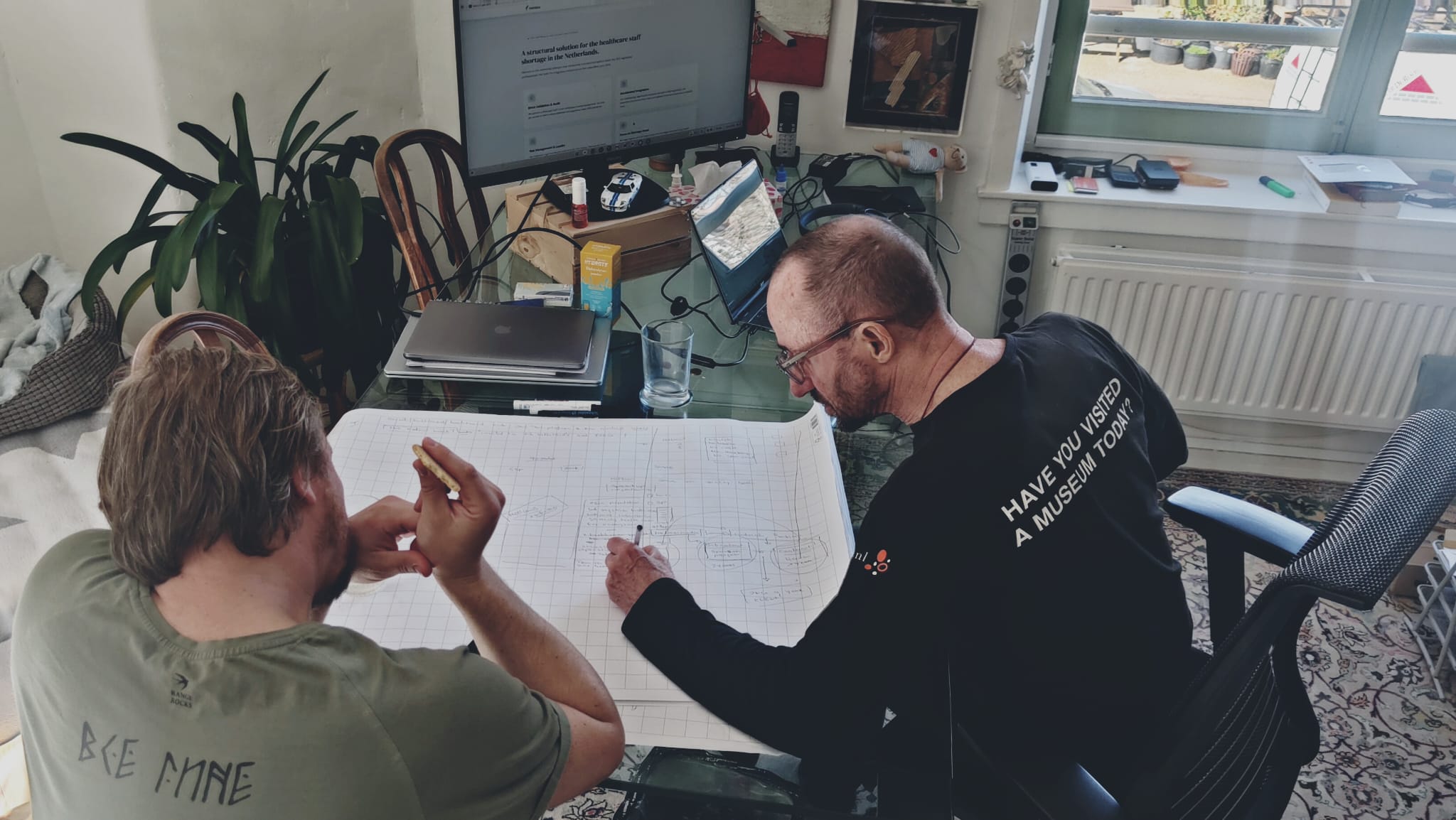
Yevhenii Butov and Bruno Servaege during a work meeting
Yevhenii Butov & Bruno Servaege: Laying the foundation for Mentora Medic's 18-month victory journey.

Expert Perspectives & Practical Guides

Netherlands 2026: Why International Doctors Are No Longer the Future, But the Only Solution Today
Big Registratie

Netherlands 2026: Why International Doctors Are No Longer the Future, But the Only Solution Today

For years, people talked about 2026 as some distant point of a "healthcare personnel crisis." Today, in mid-April 2026, we are living right in the middle of it. Specialist waiting lists have become the norm, and the pressure on the system has reached its limit. But while hospitals are desperately searching for staff, a massive, underutilized resource remains right beside them: hundreds of international doctors who already live in the Netherlands and are ready to work.** The time for "discussion" is over. The question is no longer if we should involve them, but how fast we can integrate them into the system. The Integration Gap: The Price of Delay Most international doctors I talk to daily are professionals with 10–15 years of experience. They know how to treat patients. The challenge lies in the "last mile": medical language and specific local protocols. Every month a specialist spends waiting for paperwork or searching for a way into the system is a lost resource for national health. A Win-Win Strategy: Filling Vacancies Now Today, hospitals cannot afford to wait for years. Creating conditions for clinical adaptation "on the ground" is the only way to secure a loyal and qualified professional tomorrow. Investing in the adaptation of those already in the country is the shortest path to workforce stability in this challenging period. Trajectory Over Chaos In 2026, we no longer have the luxury of bureaucratic labyrinths. We need a clear trajectory: from language immersion to supervised clinical adaptation. When this "strategic bridge" is built, the BIG-registration process stops being an endurance test and becomes a clear professional milestone. Our goal is to make this path predictable for both sides. A New Global Standard We are already living in the era of global medicine. The Netherlands has the chance to lead by example in transforming international talent into part of a national solution. This is no longer a "complex case" — it is the only viable working model for modern healthcare. There are only six months left until October 2026. This is a critical window to build the routes for those who want and are able to be of service. The future of Dutch healthcare lies in the synergy of local experience and international expertise. We are on the final sprint, and this journey begins with concrete steps today. The system is changing before our eyes — the only question is, are we ready to lead that change?

Easter battle
Big Registratie

Easter battle

Integration: More Than Just a Bicycle and Local Jokes In the Netherlands, people say that true integration starts when you finally understand the local jokes and trade your car for a bicycle. But for me, real integration is about keeping your roots while mastering the new rules of the game. The Easter Egg Analogy Yesterday, we celebrated Easter. As I watched the children enthusiastically "battling" with Easter eggs, I realized how much this simple ritual mirrors the journey of a professional in a new country. The Egg is like your degree and years of experience. It’s strong, polished, and built through years of hard work and dedication. The "Battle" is the encounter with a new system. Some fear that first "crack" (a rejection or a bureaucratic hurdle), while others see it as a challenge where every hit makes you more resilient. Building the Strategic Bridge I see hundreds of talented doctors who have moved to the Netherlands. They possess incredible inner strength, but sometimes they just need the right strategic bridge so their expertise doesn't shatter against the language barrier or the complexity of the BIG-registration. At mentoramedic.nl, we don’t just "match" people. We identify high-level specialists and place them on a clear BIG-registration trajectory. We connect you with healthcare partners who provide the right environment: * Medical Dutch courses * Clinical adaptation programs * Professional mentorship Integration isn't about breaking who you are to become someone else. It’s about staying strong and finding your rightful place at a new table. Are you a medical professional looking for your trajectory in the Netherlands? Let’s build that bridge together at mentoramedic.nl. Yevhenii Butov

Bureaucracy or Opportunity? 5 Biggest Pitfalls in Preparing for BIG-registration in the Netherlands
Big Registratie

Bureaucracy or Opportunity? 5 Biggest Pitfalls in Preparing for BIG-registration in the Netherlands

I often talk with fellow medical professionals who are already here in the Netherlands. Many of them are incredible specialists with immense experience, yet they are currently "on pause". Most of the time, this pause isn't due to a lack of knowledge, but because they are simply channeling their energy in the wrong direction. Watching my friends spend years trying to "break through the wall" of BIG-registration, I realized something: the problem isn't the system itself, but the fact that we often try to navigate this path alone. Based on these stories and my own observations, I have identified 5 key pitfalls where years of life and professional confidence are most often lost: 1. The "Just Language" Trap (A certificate is only the foundation) It often feels like getting your language certificate is the final goal. In reality, it’s just the "entry ticket." Advice: The key to success is mastering Medisch Nederlands. The ability to not just speak, but to understand a patient with a regional dialect or to correctly write a professional transfer report (overdracht) is what will be tested in practice. Start learning medical terminology and protocols alongside your basic language course. 2. Lack of Clinical Environment During Preparation Technically, you don't have to work in a hospital to submit your documents to the BIG-register. However, attempting to pass the professional exams (Professional Assessment) while remaining outside the Dutch healthcare system is a massive risk. Why it matters: Examiners evaluate not only medical knowledge but also strict adherence to Dutch guidelines (Richtlijnen) and communication ethics. The fastest way to succeed is to be in an environment where this knowledge becomes part of your daily practice long before the exams. 3. The Cultural Code of Dutch Medicine Medical knowledge is universal, but systems are not. In the Netherlands, the "doctor-patient" interaction model is built on an equal partnership rather than a rigid hierarchy. Advice: Pay close attention to soft skills. The ability to handle difficult conversations (e.g., regarding palliative care) according to local standards is just as critical for BIG-registration as an accurate diagnosis. 4. The "Parallel Steps" Strategy It pains me to see specialists put their professional lives on hold for a couple of years just to study the language. This leads to a loss of clinical skills and confidence. Advice: The optimal way is to integrate into the system step-by-step. Look for positions that don’t require immediate registration but provide access to the professional community. This creates the necessary "clinical context" that will be vital during the final verification. 5. Expectation vs. Reality Bureaucratic procedures in the Netherlands are not a barrier; they are a strictly regulated process. Those who view this path as part of their professional adaptation reach their goal much faster than those waiting for "instant results" without a deep dive into the system. This is a tough journey, and I’m not going to say there is a "magic button" that solves everything in a week. But I know for sure: those who stop waiting for the "perfect moment" (when my Dutch is flawless, when I have every single paper ready) and start entering the system in parallel, achieve results significantly faster. The path to BIG is not about bypassing the system—it’s about becoming a part of it today. If you are currently navigating this labyrinth, don’t isolate yourself. Reach out, share your experience. Finding the right direction is always easier together. What has been the biggest challenge for you so far? Yevhenii Butov

Everything you need to know about the BIG registration and our platform.

BIG stands for Professions in Individual Healthcare (Beroepen in de Individuele Gezondheidszorg). In the Netherlands, BIG registration is legally required for all healthcare professionals who want to use protected titles or perform reserved procedures. Without a BIG registration, you are not allowed to practice as a dentist, doctor, or nurse in the Netherlands.
The BIG registration process takes an average of 6 to 18 months for foreign healthcare professionals. The timeline depends on your country of origin, the completeness of your documentation, and whether you need to take an additional competence assessment. Doctors from non-EU countries typically require more time due to extra verification steps.
For BIG registration as a foreign dentist, you need: a legalized diploma with apostille, a certified transcript, a Certificate of Current Professional Status (CCPS) from your home country, a Certificate of Good Conduct (VOG), proof of Dutch language proficiency (minimum B2 level), and a valid ID. All documents must be translated by a sworn translator.
The language requirements vary by profession. Level B1 is required for mbo nurses and VIG (plus mandatory English reading). Level B2 is required for hbo nurses (plus mandatory English reading). Level B2+ is required for doctors and dentists, along with English B2 (State Exam NT2 Program II = B2 is insufficient by itself for them; a specific B2+ certificate like Babel or Radboud in'to Languages is mandatory). Certificates must not be older than 2 years and a course attendance certificate is insufficient.
Yes, Ukrainian healthcare professionals with temporary protection (Directive 2001/55/EC) can work in healthcare in the Netherlands. However, they must go through the standard BIG registration process. Mentora specifically guides Ukrainian dentists, doctors, and nurses through this process, from diploma legalization to actual BIG registration.
The application for the Declaration of Professional Competence at the CIBG and the evaluation by the CBGV are free (€0). The BIG registration itself costs €85 (increasing to €121 as of January 1, 2027). In addition, you pay for the BI-toets (mbo nurses: €450, dentists: €1,500, doctors: to be determined by Radboudumc). Other costs such as legalization, sworn translations, and language courses are variable depending on your situation.
Mentora is een digitaal platform dat buitenlandse medische professionals begeleidt bij het hele BIG-registratietraject in Nederland. We helpen met documentbeheer, voortgangsmonitoring, matching met Nederlandse zorgwerkgevers en persoonlijke begeleiding. Via ons platform hebben zowel kandidaten als werkgevers realtime inzicht in de voortgang van het registratieproces.
Yes, under Article 38 of the Dutch BIG Act (task delegation and supervision), it is possible to work clinically in supporting or delegated roles, such as medical assistant or basic doctor under supervision. A BIG-registered colleague maintains overall responsibility for the procedures and must verify your competence.
The supervision route is a temporary working arrangement where you perform delegated clinical tasks under the direct supervision of a BIG-registered colleague, without independent license to practice. Full BIG registration is the final goal where your foreign diploma is officially recognized, and you can practice independently under your protected title after meeting the language requirements and passing any required BI-toets.